SETUP ADVANCED
The 10AM Key Open
This lesson introduces the 10AM Key Open, one of the core setups I personally use when trading NQ. You will learn why the 10AM opening candle matters, how I use that candle as my entry reference, what I want price to do before I become interested in a trade, and how to recognize the difference between a clean 10AM setup and price action that should be left alone.
By the end of this lesson, you should understand the basic structure of the 10AM Key Open setup and why the 10AM opening price becomes important only after the market creates the correct manipulation and retracement relationship.
You will learn how to:
• Mark the 10AM Open correctly
• Recognize the manipulation phase
• Identify the directional impulse that follows
• Measure that move using Fibonacci
• Determine whether the 10AM Open sits between the 0.50 and 0.79 retracement levels
• Understand when the 10AM Open becomes a valid limit-entry level
• Recognize when there is no setup
The simplified sequence is:
10AM Open → Manipulation → Directional Impulse → Fibonacci Measurement → 0.50–0.79 Alignment → Limit the 10AM Open
1. What Is the 10AM Key Open?
The 10AM Key Open is a setup I use during the New York session built around one specific price:
The price NQ opens at exactly 10:00 AM Eastern Time.
This is important because I am not using the entire 10AM candle as my entry area.
I specifically care about the 10AM opening price.
Once 10:00 AM arrives, I mark that price with a horizontal level.
For example:
10AM Open:
20,300
That level stays on my chart while I watch what price does next.
But marking the level does not mean I immediately enter.
The 10AM Open first needs to become part of a valid setup.
2. The 10AM Open Is the Potential Entry — Not the Initial Signal
This distinction is extremely important.
When 10:00 AM arrives, I am not saying:
“Price opened at 20,300, so I am buying or selling 20,300.”
Instead, I am waiting for the market to create information around that price.
The sequence begins with:
Manipulation.
Only after the manipulation and directional move develop do I determine whether the 10AM Open qualifies as my entry.
So the 10AM Open is my potential entry price.
The market still has to earn that setup.
3. What Do I Mean by Manipulation?
For this setup, I first want price to manipulate away from the 10AM Open.
In simple terms, price initially pushes one direction away from the opening level before the larger directional move becomes clear.
This matters because the manipulation helps create the swing that will eventually be measured.
Think of it as the market first moving away from the 10AM Open and creating an extreme.
That extreme becomes important when direction changes and price begins expanding in the opposite direction.
4. Bullish Manipulation
For a potential bullish setup, price may first manipulate below the 10AM Open.
Example:
10AM Open:
20,300
Price initially falls:
20,280
20,250
20,220
Suppose the manipulation reaches:
20,200
At this point, I still do not have a long simply because price went below the 10AM Open.
I wait to see whether buyers actually take control and create a bullish directional move.
The manipulation creates the low.
The following bullish movement gives me the impulse I can measure.
5. Bearish Manipulation
For a potential bearish setup, price may first manipulate above the 10AM Open.
Example:
10AM Open:
20,500
Price initially pushes higher:
20,525
20,550
20,580
Suppose the manipulation reaches:
20,600
Again, I am not automatically shorting because price traded above the 10AM Open.
I wait for sellers to take control and create bearish movement away from that manipulation high.
The manipulation creates the high.
The bearish impulse gives me the move I can measure.
6. Manipulation Alone Is Not the Trade
This is where beginners can get themselves into trouble.
They may think:
“Price went below 10AM. Buy.”
Or:
“Price went above 10AM. Sell.”
That is incomplete.
After manipulation, I still need price to create a directional impulse.
For a bullish setup:
Manipulation lower → bullish expansion
For a bearish setup:
Manipulation higher → bearish expansion
The directional expansion gives us enough information to begin measuring the move.
7. Why the Impulse Matters
The impulse is the directional move that develops after manipulation.
It gives us a measurable price range.
Instead of guessing whether the 10AM Open is a good retracement price, I use Fibonacci to determine where the 10AM Open actually sits inside that move.
This makes the setup objective.
The question becomes:
Is the 10AM Open inside the retracement area I require?
For this setup, my range is:
0.50 to 0.79
If the 10AM Open is inside that range, I become interested in using the level for my limit entry.
If it is outside that range, I do not have the same setup.
8. Understanding the 0.50–0.79 Range
Once the manipulation and directional impulse have developed, I measure the move with Fibonacci.
The area between 0.50 and 0.79 is the retracement zone I want the 10AM Open to fall inside.
The exact 10AM Open does not need to equal 0.50.
It does not need to equal 0.79.
It simply needs to sit somewhere inside the range.
So if the Fibonacci measurement shows:
0.50 level:
20,320
0.79 level:
20,270
and the 10AM Open is:
20,300
Then:
20,300 is inside the required range.
That creates the alignment I am looking for.
9. Why We Measure Instead of Guessing
Without measurement, a trader may look at the chart and think:
“That looks like a good pullback.”
But “looks good” is subjective.
The Fibonacci measurement gives us a repeatable question:
Is my 10AM Open inside 0.50–0.79?
Yes or no.
This prevents us from forcing the level into a setup just because we want a trade.
10. The Bullish Measurement
For the bullish version, the market first manipulates below the 10AM Open.
Then bullish expansion develops.
Once the bullish impulse is established, measure the move from the manipulation low toward the bullish impulse high.
The purpose of the measurement is not simply to draw Fibonacci on the chart.
You are checking one specific thing:
Does the 10AM Open fall between 0.50 and 0.79 of that bullish move?
If yes, the 10AM Open becomes my potential buy-limit level.
11. Bullish Example
Suppose:
10AM Open:
20,300
Price manipulates lower and creates a low at:
20,200
Then buyers take control.
NQ expands higher and reaches:
20,450
Now we have a bullish impulse.
The Fibonacci retracement is measured across that bullish move.
Suppose the measurement shows:
0.50:
20,325
0.79:
20,252.50
Our 10AM Open is:
20,300
Ask the question:
Is 20,300 between 20,325 and 20,252.50?
Yes.
That means the 10AM Open sits inside my required retracement range.
The 10AM Open now becomes the price I am watching for my limit entry.
The important part is the order:
10AM level existed first.
Manipulation happened.
Bullish impulse developed.
Fibonacci confirmed the alignment.
Then the 10AM Open became actionable.
12. What If the Bullish OTE Does Not Align?
Suppose the exact same manipulation occurs.
10AM Open:
20,300
But after measuring the bullish impulse, the Fibonacci levels are:
0.50:
20,380
0.79:
20,335
The 10AM Open is:
20,300
That means the 10AM Open is below the entire required zone.
My level does not align with the setup.
I do not move the Fibonacci.
I do not change the 10AM Open.
I do not widen the range.
I simply recognize:
The setup does not qualify under this rule.
13. The Bearish Measurement
The bearish version is the mirror image.
Price first manipulates above the 10AM Open.
Then sellers create bearish expansion.
Once that bearish impulse develops, I measure from the manipulation high toward the bearish impulse low.
Again, I am checking:
Does the 10AM Open sit inside the 0.50–0.79 retracement range?
If it does, the 10AM Open becomes the potential sell-limit level.
14. Bearish Example
Suppose:
10AM Open:
20,500
Price manipulates higher and reaches:
20,600
Then sellers take control.
Price expands lower to:
20,350
The bearish impulse is now established.
After measuring the move, suppose:
0.50:
20,475
0.79:
20,547.50
The 10AM Open is:
20,500
Is 20,500 inside the range?
Yes.
The 10AM Open now has the alignment required for the bearish setup.
That makes the 10AM Open the potential sell-limit price.
15. This Is Why the Setup Is Called a Key Open
The opening price is not important simply because the clock says 10:00.
It becomes important because the later price action creates a retracement relationship back to that exact opening price.
The sequence gives the level meaning.
That is why I am not blindly entering every 10AM Open.
I want:
Manipulation.
Directional expansion.
Correct Fibonacci alignment.
Then the open becomes my entry level.
16. The Limit Entry
Once the setup qualifies, I am not waiting for price to return and then deciding whether the 10AM Open is interesting.
I already know the level I care about.
The 10AM Open is the level.
If my Fibonacci measurement confirms that the open sits inside the 0.50–0.79 range, I can use the 10AM Open as my limit-entry price according to the rest of my risk plan.
That is one of the biggest differences between this setup and simply trading a normal support or resistance reaction.
The entry level is already defined.
17. Why a Limit Order?
A limit order allows the trader to specify the exact price they want.
Example:
10AM Open:
20,300
Valid bullish alignment confirmed.
Potential entry:
Buy Limit 20,300
If price retraces to 20,300, the order may fill.
If price never comes back to 20,300, there may be no entry.
That is okay.
The setup does not require chasing price because it moved in the expected direction.
18. A Correct Read Can Still Produce No Entry
Imagine:
10AM Open:
20,300
Manipulation:
20,200
Bullish impulse:
20,450
The 10AM Open falls perfectly inside 0.50–0.79.
But price only retraces to:
20,315
Then rallies to:
20,600
Your market read may have been excellent.
Your limit simply did not fill.
That is not a losing trade.
That is a missed entry.
Do not change 20,300 to 20,315 after seeing the move.
Your setup had a defined price.
19. Do Not Chase After the Limit Is Missed
This is where discipline becomes important.
If your entry was:
20,300
and price only reaches:
20,315
before rallying 150 points, you may feel the urge to buy at:
20,340
20,350
20,370
But now you are no longer trading the original setup.
You are chasing the result of the setup.
Those are two different things.
The 10AM Key Open gives you an exact reference.
Either the market gives you the price or it does not.
20. What Makes This a No-Trade?
For this beginner framework, the 10AM Key Open should be considered incomplete when:
• There is no clear manipulation
• There is no directional impulse afterward
• The impulse cannot be measured clearly
• The 10AM Open falls outside 0.50–0.79
• The limit price is never reached
• The trader misses the level and chases
• The setup occurs outside your permitted conditions
• The trade does not fit your risk plan
Knowing when the setup is absent is just as important as recognizing when it is present.
21. The Setup Is Not “Fibonacci Trading”
The Fibonacci tool helps us measure the relationship between the impulse and the 10AM Open.
The tool itself does not create the trade.
The actual logic is:
There is a key opening price.
The market manipulates away from that price.
A directional impulse forms.
That impulse creates a measurable retracement.
The original 10AM Open happens to sit inside the required retracement area.
That alignment gives us our entry framework.
Fibonacci is the measuring tool.
It is not the entire strategy.
22. Do Not Move the Fib to Make the Setup Work
This is another major beginner mistake.
Suppose you measure the impulse and the 10AM Open falls outside 0.79.
A trader may redraw the Fibonacci from a slightly different high or low until the 10AM Open finally fits.
That destroys the objectivity of the setup.
The swing being measured should be the actual manipulation-to-impulse move defined by the model.
You do not change the measurement because you want an entry.
23. Your Four Questions
When studying the setup, simplify everything down to four questions.
Question 1
Where is my 10AM Open?
Question 2
Where did Manipulation occur?
Question 3
What directional impulse developed afterward?
Question 4
Does my 10AM Open sit between 0.50 and 0.79 of that move?
If the answer to Question 4 is no:
There is no Key Open entry under this setup.
If the answer is yes:
The 10AM Open becomes the limit-entry level.
Common Beginner Mistake
The biggest mistake is treating the 10AM Open as automatically tradable.
Example:
10AM Open:
20,300
Price manipulates lower.
The trader immediately places a buy limit at 20,300.
But the bullish impulse that follows produces a Fibonacci range where:
0.50:
20,250
0.79:
20,210
The 10AM Open at 20,300 is not inside the required zone.
The trader skipped the measurement.
They traded the level without confirming that the level had the required alignment.
The correct sequence is:
MARK → WAIT → MEASURE → VERIFY → LIMIT
Not:
MARK → TRADE
Practical Example
Suppose NQ reaches 10:00 AM.
10AM Open:
20,700
You mark:
20,700
Price begins moving lower.
20,680
20,650
20,620
20,590
The manipulation low eventually forms at:
20,580
You do not enter yet.
Price then reverses and begins expanding higher.
20,620
20,670
20,720
20,770
20,820
A bullish impulse has formed.
Now you measure the move.
Manipulation low:
20,580
Impulse high:
20,820
Total move:
240 points
Suppose your Fibonacci shows:
0.50:
20,700
0.79:
20,630.40
Your 10AM Open is:
20,700
The open sits at the beginning of your required 0.50–0.79 range.
That qualifies under the simplified rule.
Potential entry:
Buy Limit 20,700
Now imagine price retraces:
20,790
20,760
20,730
20,705
20,700
The limit is reached.
That is fundamentally different from simply buying 20,700 because it happened to be the 10AM opening price.
The market first created the structure required to make 20,700 relevant.
Knowledge Check
Question 1
What exact price do we mark at 10AM?
A. The 10AM candle high
B. The 10AM candle low
C. The exact 10AM opening price
D. The previous day close
Answer: C
Question 2
Do we immediately enter at the 10AM Open?
A. Yes
B. No
Answer: B
Question 3
What do we wait for first?
A. Manipulation
B. A random FVG
C. Another market to move
D. The closing bell
Answer: A
Question 4
After Manipulation, what do we need?
A. Directional impulse or expansion
B. Immediate limit entry
C. A second account
D. A different opening price
Answer: A
Question 5
What range must contain the 10AM Open?
A. 0.10–0.30
B. 0.25–0.50
C. 0.50–0.79
D. 0.90–1.00
Answer: C
Question 6
If the 10AM Open is outside 0.50–0.79, what happens?
A. Move the Fibonacci until it fits
B. Use the level anyway
C. The setup does not qualify under this rule
D. Increase contract size
Answer: C
Question 7
When the alignment qualifies, what price becomes the limit entry?
A. The manipulation extreme
B. The 10AM Open
C. The 0.79 level automatically
D. The current market price
Answer: B
Question 8
What should you do if price never retraces to the 10AM Open?
A. Chase
B. Change the entry
C. Accept the missed entry
D. Double your contracts
Answer: C
Question 9
For a basic bullish setup, Manipulation generally occurs on which side of the 10AM Open?
A. Above
B. Below
Answer: B
Question 10
For a basic bearish setup, Manipulation generally occurs:
A. Above the 10AM Open
B. Below the 10AM Open
Answer: A
Lesson Assignment
For this assignment, use completed NQ sessions or Bar Replay.
Do not focus on profits yet.
Complete at least 15 examples.
For every example, record:
Date:
10AM Open:
Manipulation direction:
Above
or
Below
Manipulation extreme:
Bullish or bearish impulse:
Impulse extreme:
0.50 level:
0.79 level:
Was the 10AM Open inside 0.50–0.79?
Yes
or
No
Did price return to the 10AM Open?
Yes
or
No
Would the limit have filled?
Yes
or
No
Screenshot:
Then classify the session:
• Valid bullish Key Open
• Valid bearish Key Open
• Invalid OTE alignment
• No clear manipulation
• No clear impulse
• Valid setup but missed limit
The purpose of this assignment is to stop seeing “10AM” as an automatic signal.
You are training yourself to recognize the entire sequence.
Key Takeaways
• The 10AM Key Open uses the exact opening price at 10:00 AM Eastern Time.
• The 10AM Open is the potential entry level, not an automatic signal.
• Manipulation must occur first.
• A directional impulse must develop after the manipulation.
• The impulse is measured using Fibonacci.
• The required retracement range is 0.50–0.79.
• The 10AM Open must sit inside that range.
• If the open is outside the range, the setup does not qualify under this rule.
• Once the alignment qualifies, the 10AM Open becomes the limit-entry level.
• If price does not return to the 10AM Open, there may be no entry.
• Missed trades should not be chased.
• Fibonacci is being used as a measurement tool.
• Do not redraw the measurement simply to make the setup qualify.
The setup can be remembered as:
10AM OPEN
↓
MANIPULATION
↓
IMPULSE
↓
MEASURE
↓
IS 10AM INSIDE 0.50–0.79?
↓
YES = LIMIT THE 10AM OPEN
NO = NO KEY OPEN ENTRY
Final Lesson Reminder
The beginner version of my 10AM Key Open is not complicated.
Do not start by trying to predict where NQ is going.
Start with the process:
Mark the 10AM Open.
Wait for Manipulation.
Wait for the directional move.
Measure it.
Check 0.50–0.79.
If the 10AM Open aligns, that is the level I want to limit.
The setup is not created because 10AM arrived.
The setup is created when the market produces the correct relationship back to the 10AM Open.
Educational Disclaimer
Tick Lab is provided for educational and informational purposes only. The 10AM Key Open, Fibonacci retracement measurements, and limit-entry concepts do not guarantee profitable trades. Futures trading involves substantial financial risk, and limit orders are not guaranteed to fill. Students should backtest the framework and practice in simulation before considering real financial risk.
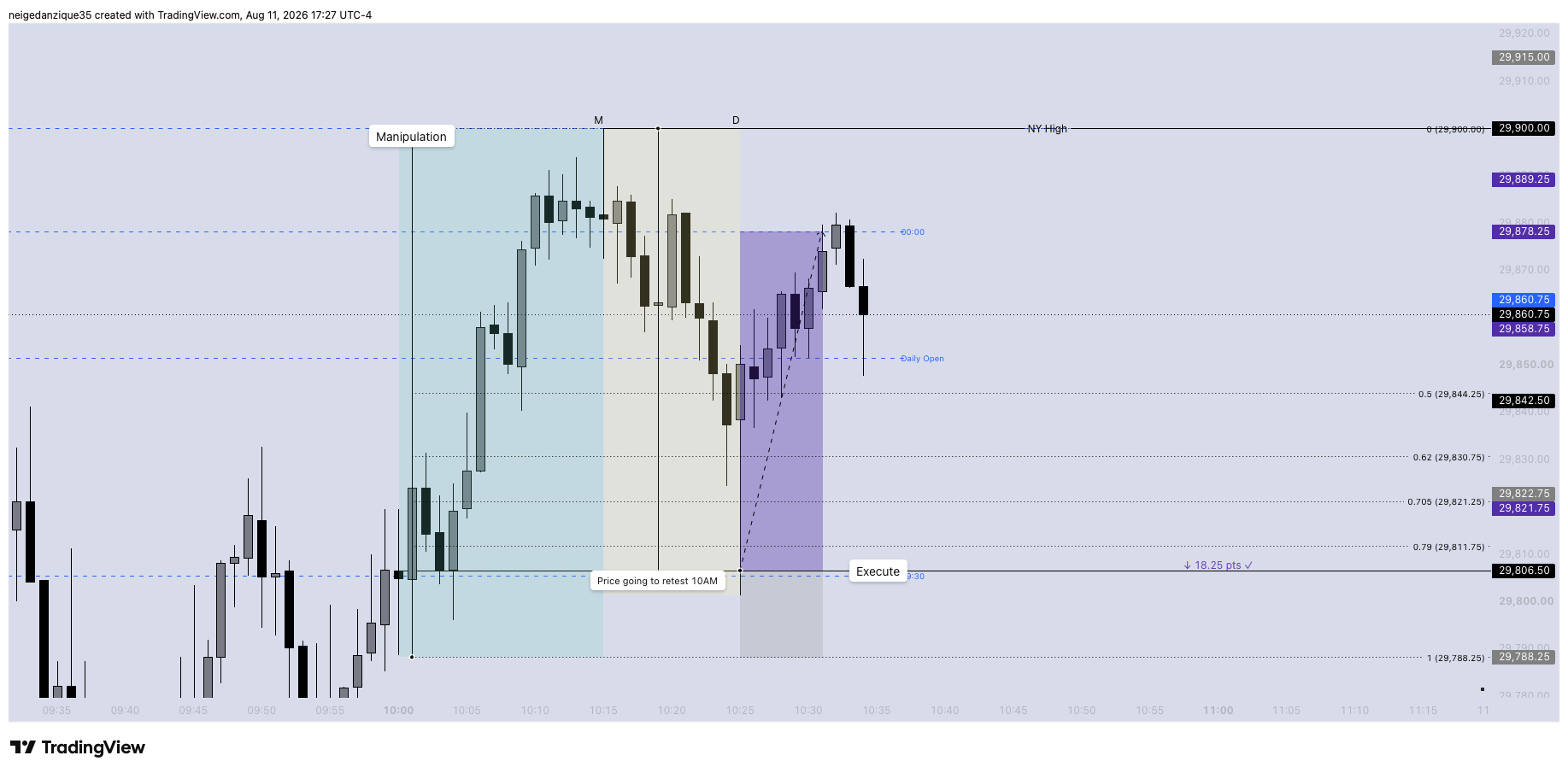 Image
Image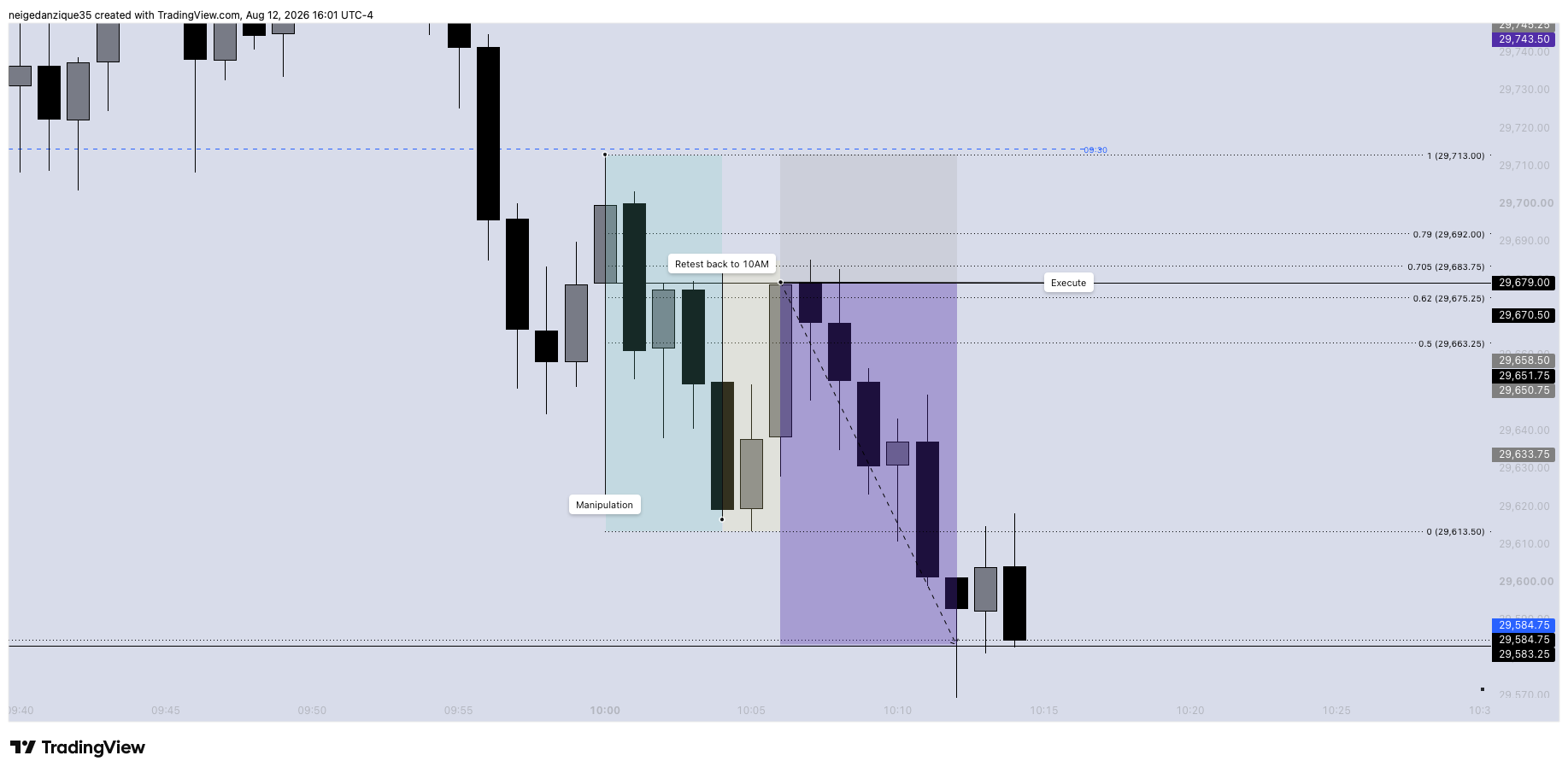 Image
Image